
Programming Basic in Industrial Automation
In industrial settings—from manufacturing plants and energy operations to water treatment, agriculture, and mining—programming is the key that makes automated systems function reliably and efficiently. Industrial automation programming controls physical equipment in real time: starting pumps, opening valves, triggering alarms, or adjusting motor speeds. Unlike general software development, it emphasizes safety, fault tolerance, real-time response, and ease of maintenance in harsh environments like dust, vibration, extreme temperatures, or remote locations.
Why Programming Matters in Industrial Settings
Automation programming differs from app or web development because it directly interfaces with machinery. Errors can cause safety hazards, production stops, or equipment failure, so programs stress reliability, built-in safety features (interlocks, fail-safes), and straightforward troubleshooting.
The field serves diverse sectors: oil & gas (wellhead and pipeline controls), agriculture (irrigation and pumping), water/wastewater (flow and treatment monitoring), manufacturing (conveyors and robotics), and more. Robust programming reduces downtime, improves energy efficiency, ensures regulatory compliance, and supports remote oversight in spread-out operations.
The Core Tool: Programmable Logic Controllers (PLCs)
The foundation of most industrial automation is the PLC—a rugged computer engineered for factory and field use. It withstands tough conditions far better than standard PCs.
A PLC operates in a repeating scan cycle (often milliseconds long):
- Read inputs (sensors, switches, pushbuttons).
- Execute the program logic.
- Update outputs (motors, valves, lights, alarms).
- Repeat.
PLCs support multiple brands (Allen-Bradley/Rockwell, Siemens, Schneider, Automation Direct, etc.), allowing flexibility for retrofits or matching existing plant equipment.
Ladder Logic: The Most Common Starting Point
Ladder Logic (Ladder Diagram, LD) is the dominant programming language in industry due to its similarity to traditional electrical relay schematics—making it accessible for electricians, technicians, and engineers.
Key elements:
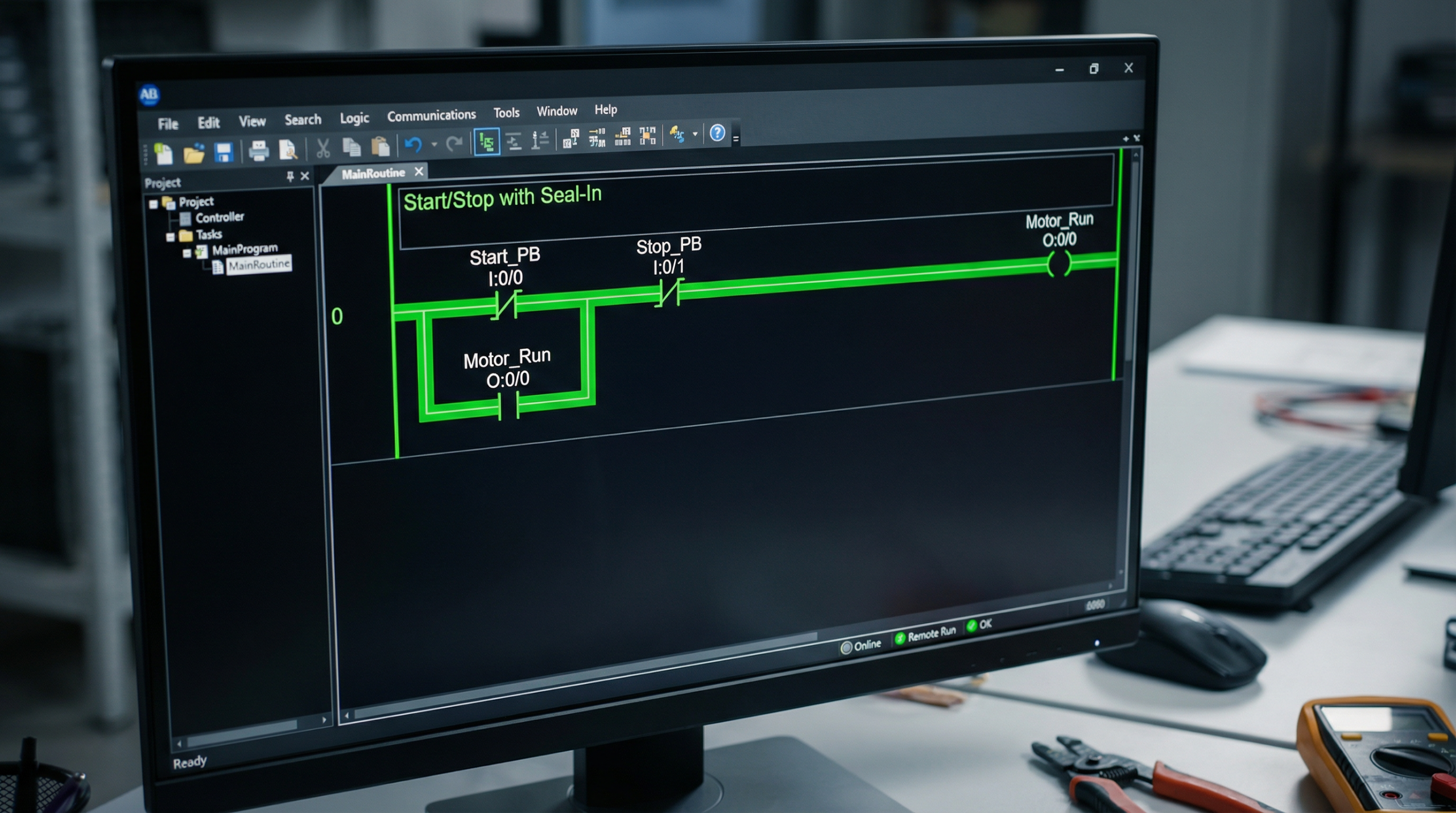
- Contacts: Inputs. Normally Open (NO/XIC) closes when true; Normally Closed (NC/XIO) opens when true.
- Coils: Outputs. Energizing turns on the device.
- Branches/parallels: Enable AND/OR logic.
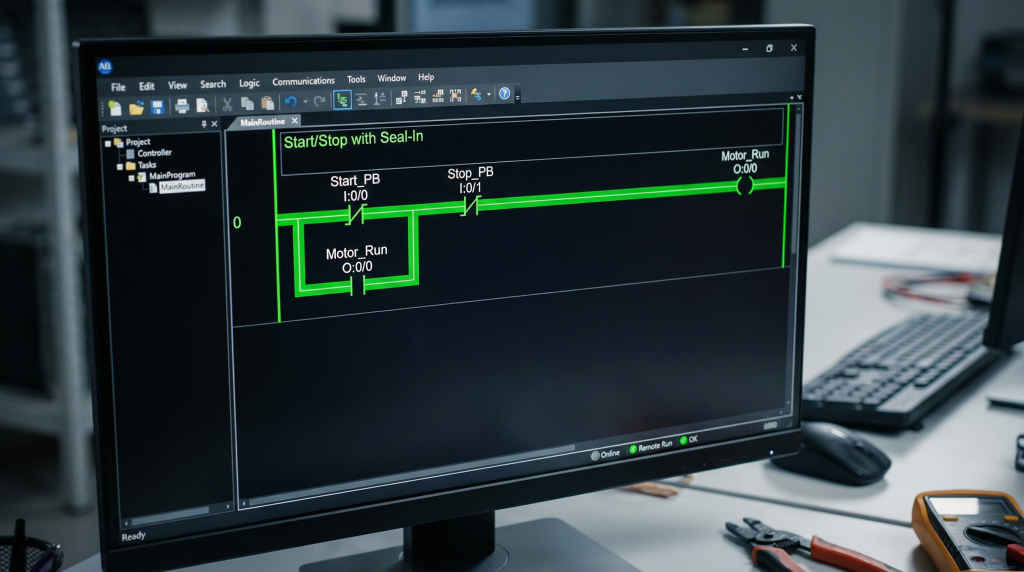
- Top path: Start_Button (NO) AND NOT Motor_Running (via NC) energizes Motor_Coil.
- Parallel branch: Once running, Motor_Running (NO) seals the coil on.
Human-Machine Interfaces (HMIs) and SCADA Basics
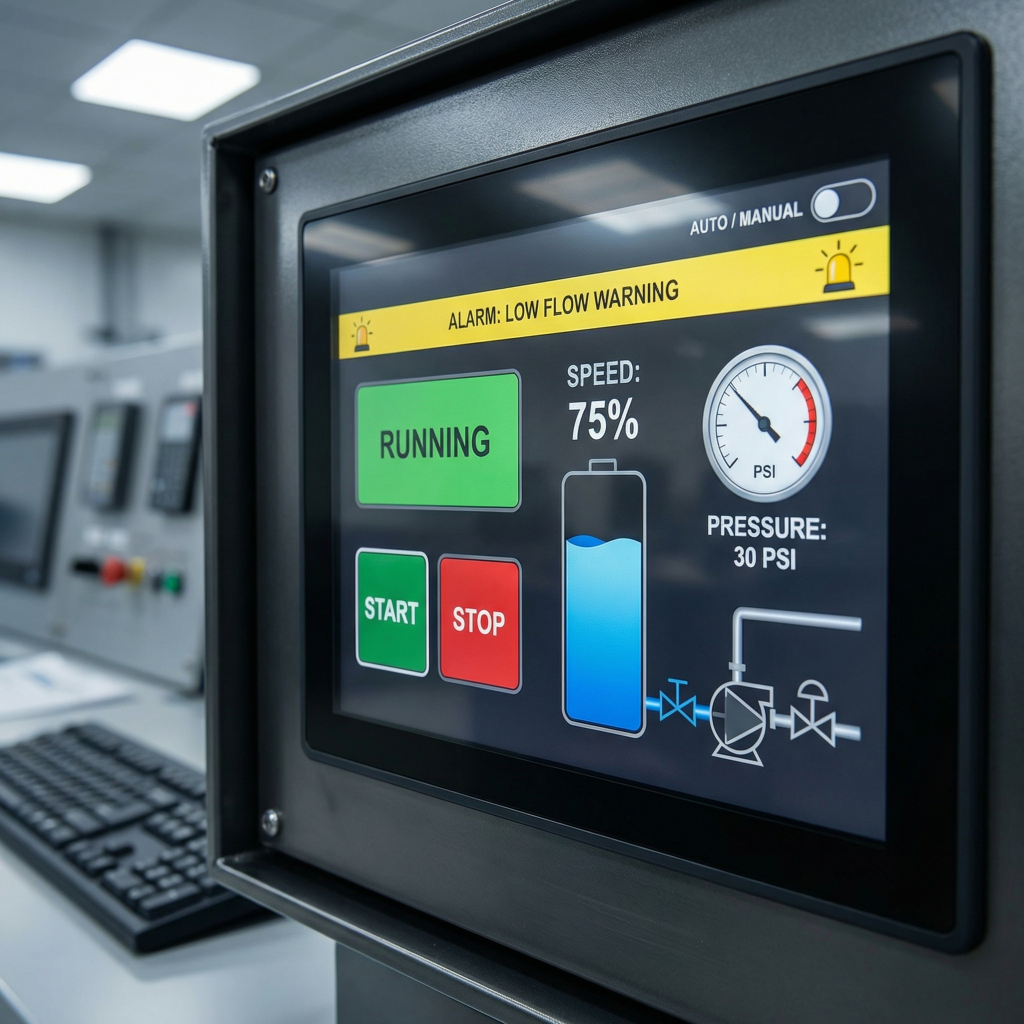
After PLC logic handles control, visibility comes via HMIs—touchscreen panels near equipment showing:
- Real-time status (e.g., “Pump Running – 75% Speed”).
- Trends and data.
- Alarms and operator controls (start/stop, setpoints).
HMI programming involves designing screens, linking PLC “tags” (data points like temperature or speed), adding graphics/buttons, and configuring alarms.
For broader oversight—especially multi-site or remote—SCADA systems provide centralized monitoring, historical logging, reporting, and notifications over networks/internet.
VFD Programming and Simple Control Enhancements
Variable Frequency Drives (VFDs) adjust motor speeds for energy savings and precise control (e.g., maintaining tank levels or flow rates). Programming integrates VFDs with PLCs: setting ramps, using PID loops for stable regulation, or auto-start based on demand.
Basic example: PLC monitors a level sensor and modulates VFD speed to hold steady levels—avoiding overflows or dry-running.
Safety, Testing, and Real-World Application
Safety is non-negotiable: include interlocks (no start if guard open), fault detection, and fail-safe modes. Programs undergo simulation testing, then on-site commissioning with verification and operator training.
Certified panels (e.g., UL 508A) often enclose these systems for code compliance in hazardous areas.
Career Progression in Industrial Automation Programming
The industrial automation field—encompassing PLC programming, controls engineering, and related roles—offers structured advancement with strong demand, competitive pay, and opportunities for hands-on to leadership growth. Many enter from electrician, maintenance, or engineering backgrounds; others via trade programs, apprenticeships, or self-study with simulators and online resources.
Typical progression (U.S. averages, based on 2025–2026 data from sources like ZipRecruiter, Glassdoor, and industry reports; salaries vary by location, industry, certifications, and overtime/bonuses):
- Entry-Level (0–3 years): Automation Technician, PLC Technician, or Junior Controls Technician. Duties include panel wiring, basic ladder edits, troubleshooting, I/O testing, and field support under supervision. Often starts from maintenance/electrician roles. Average salary: $55,000–$80,000 (entry PLC programmer around $65,000–$85,000; some reports show $80,000+ averages for entry-level in certain areas).
- Mid-Level (3–8 years): Controls Engineer, Automation Engineer, or PLC Programmer. Independent design of systems, complex logic (timers, PID, sequences), HMI/SCADA integration, project commissioning, client work, and multi-platform experience. Certifications (e.g., ISA CCST Level 1, Rockwell/Siemens credentials) boost advancement. Average salary: $85,000–$110,000 (mid-level PLC/controls roles often $90,000–$100,000+).
- Senior/Lead Level (8+ years): Senior Controls Engineer, Lead Automation Engineer, or Project/Technical Lead. Involves architecture design, team mentoring, large-scale projects, specialization (e.g., hazardous areas, robotics), or management. Some move to consulting, R&D, or operations oversight. Average salary: $110,000–$130,000+ (senior roles up to $140,000–$150,000 in high-demand sectors).
Progression accelerates with hands-on projects, certifications (ISA CCST Levels 1–3 build from technician to supervisory expertise), portfolios, and skills in emerging areas like IIoT or cybersecurity. The field rewards practical experience—many build home labs for practice—and offers paths in technical specialization or management.
The Value of Solid Basics
Mastering fundamentals—inputs/outputs, ladder logic patterns like seal-ins, alarms, and safety—creates reliable systems and builds a strong career foundation. Free simulators from major PLC brands let beginners experiment with simple programs.
In an industry where uptime directly impacts productivity and safety, effective programming delivers dependability over complexity. Whether maintaining existing setups or designing new ones, these basics remain essential across manufacturing, energy, utilities, and beyond.